Should there be more risk premium in UK assets
Makerfield by election, leadership election and possible shift left....

TLDR
• UK fiscal concerns could re-emerge into the Makerfield by-election / leadership backdrop, particularly if markets begin pricing a more leftward fiscal tilt. (Discussion of the UK Fiscal rules below)
• A contested leadership process or perceived shift toward looser fiscal policy risks reviving a modest UK fiscal risk premium in GBP, especially versus EUR. (Sequence of events below too)
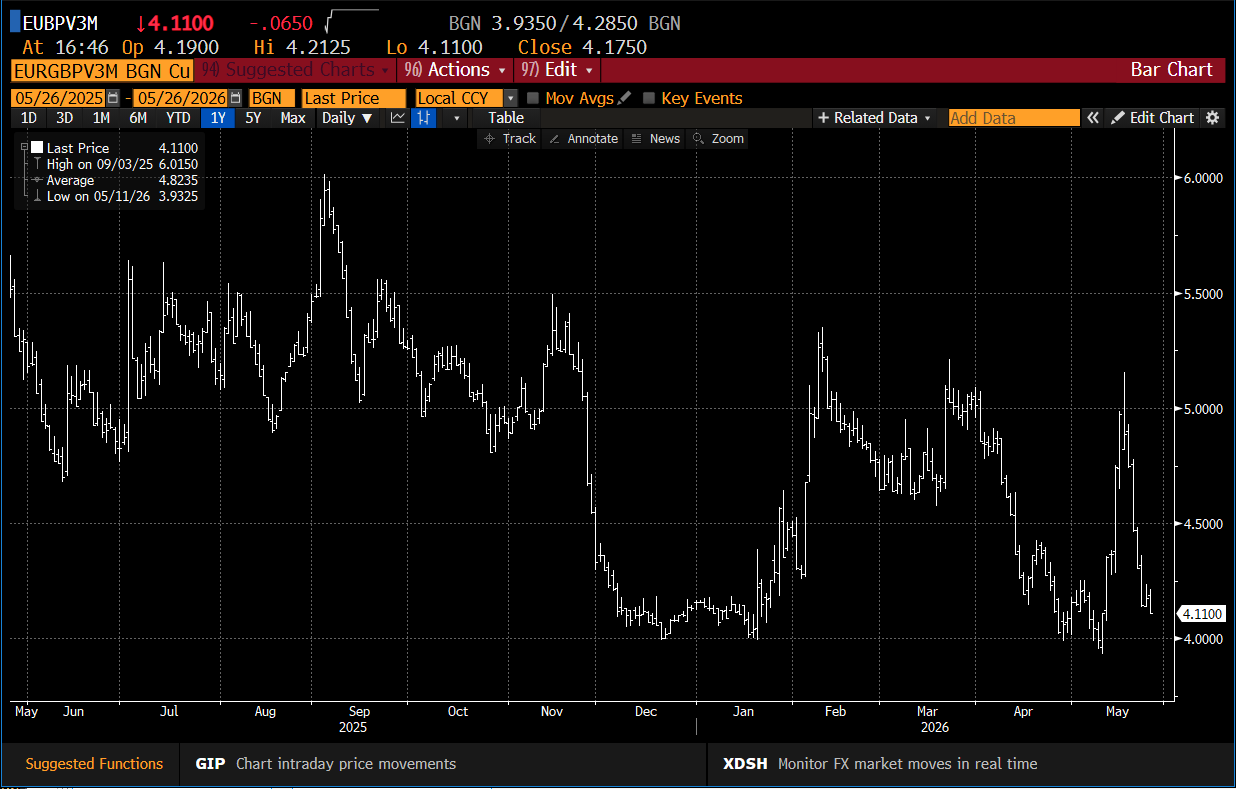
• FX volatility looks inexpensive: 1m EURGBP implied ~4.0, 3m ~4.1 — low versus a potentially eventful political calendar, & a widening political distribution. (18 June by-election → July/August leadership manoeuvring → autumn fiscal narrative)
• The key question is not whether fiscal rules are technically met, but whether investors believe debt dynamics remain credible.
• A combination of a cash trade along with a cheap optionality / convexity trade.
Macro backdrop: why fiscal worries matter
The UK fiscal rules are permissive enough that debt could move through 100% of GDP without a formal breach, provided debt is forecast to fall in the target year and current spending is financed over the medium term.
Markets, however, care about something different:
credibility.
If a by-election result catalyses leadership speculation, and that leadership process shifts the policy debate left — higher spending, weaker fiscal discipline, looser borrowing assumptions, or a softer stance on fiscal consolidation — investors could begin attaching a modest fiscal premium to UK assets again. (Andy Burnham has said he will abide by the Fiscal Rules but if you look at the rules in detail, debt could increase)
This does not need to become a repeat of the 2022 mini-budget episode.
The transmission channel could simply be:
political uncertainty → fiscal uncertainty → higher term premium → softer GBP
particularly if long-end gilts underperform and foreign investors demand more compensation for holding sterling assets.
Importantly, GBP today does not trade with a large fiscal discount embedded.
That makes repricing risk asymmetric.
Why options matter: Cheap vol on a widening political distribution.
EURGBP implied volatility around:
1m ~4.0
3m ~4.1
screens as low if the market is about to navigate:
a parliamentary by-election,
possible leadership manoeuvring,
renewed debate around fiscal credibility, and
a potential shift in UK political expectations.
You are effectively paying historically low insurance premia for a political/fiscal narrative that could re-enter markets. The event is not the by-election. The event is the political uncertainty window that the by-election may unlock.
The argument is not: “GBP collapse.”
It is: “The probability distribution may be too narrow.”
Trade ideas
1. Long EURGBP topside optionality (cleanest expression)
Theme: modest UK fiscal premium emerges.
Structure ideas:
1–3m EUR call GBP put
modest OTM strikes to cheapen carry - for example, a 2 month 0.8725 EUR call costs 0.428%%, 0.8644 spot & Implied Volatility of 4.2428
Expression: low premium, convex exposure to UK political/fiscal repricing.
Why EURGBP?
cleaner fiscal relative story versus EUR
avoids broader USD macro noise (Fed, risk sentiment, oil, tariffs, positioning)
GBP underperforms not because Europe looks great, but because UK risk premium rises.
2. EURGBP call spread (better carry discipline)
If outright premium sensitivity feels expensive relative to conviction:
Example: 2 month expiry, buy 0.87 EUR call, sell 0.88 EUR call, net costs 0.278%, 0.8644 spot ref
Rationale:
lower premium outlay
monetises a moderate repricing scenario rather than crisis pricing
Good fit if your view is: “sterling softens modestly” rather than “sterling dislocates.”
3. Long GBP vol rather than direction
If conviction is on underpriced uncertainty rather than FX direction:
long EURGBP strangle / straddle around the political window
or long GBP crosses where vol screens compressed
View: market is underpricing event risk.
This is arguably the purer expression if you think: “I know something happens, less sure on direction.”
4. Relative fiscal-risk basket
More thematic:
Short GBP versus:
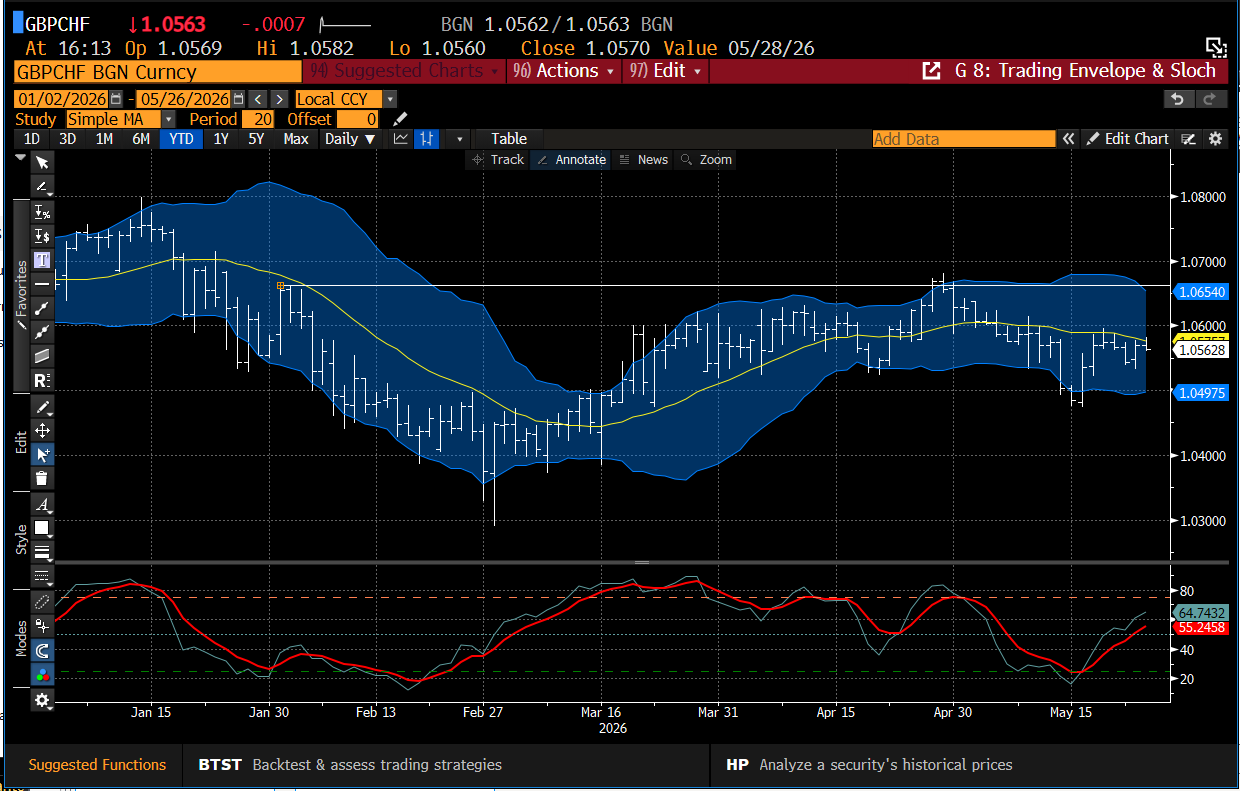
Switzerland-linked FX (CHF)
selective EUR exposure; USD if you think the Fed is under priced for the potential.
Idea: fiscal premium widens in GBP while funding/safe-haven currencies outperform.
Risks to the thesis
By-election proves politically irrelevant
Leadership contest fails to materialise
Market sees any shift as cosmetic rather than fiscal
UK growth/inflows remain supportive of GBP
Vol stays structurally depressed and theta wins
Bottom line
This feels like a cheap convexity trade.
If politics turns noisy and fiscal concerns re-emerge, GBP may not collapse — but a modest fiscal premium could reappear faster than current vol pricing implies.
At ~4 implied in EURGBP, the market looks fairly relaxed about that possibility.
Charts
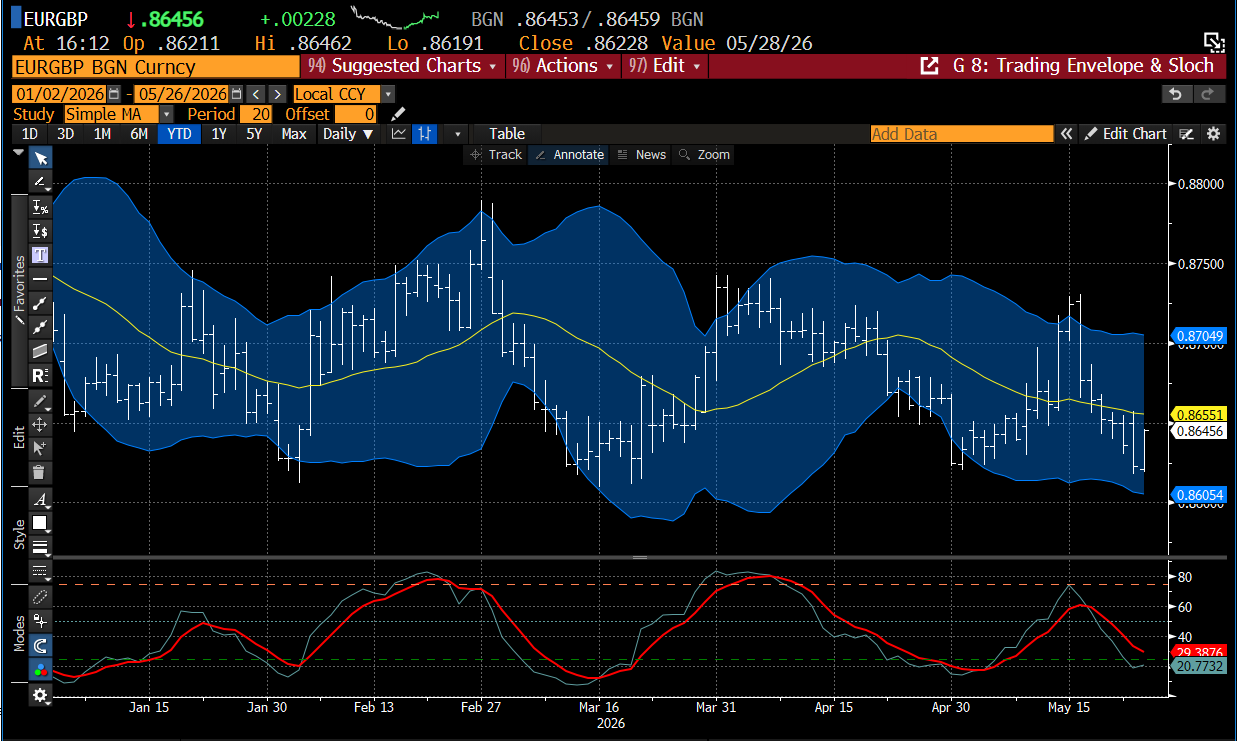
EURGBP
3 month FX Implied Volatility
EURGBP spot chart - 0.8600/10 area support
GBPCHF
Here is the sequence markets would likely think about:
1. Makerfield by-election: 18 June 2026
Andy Burnham first needs to win the parliamentary seat and return to Westminster. That is the gating event.
2. Immediate post-election pressure (late June–July)
If Burnham wins and Labour pressure on Starmer intensifies, a formal leadership challenge could emerge quite quickly. Under Labour rules, a challenger needs backing from 20% of Labour MPs (about 81 MPs currently) to trigger a contest against a sitting leader.
Several recent reports are already discussing a contest potentially beginning this summer if Burnham returns to Parliament and support coalesces. ITV explicitly described a path to a challenge “later this summer.”
3. Leadership election process itself: likely weeks to a few months
Once triggered, Labour leadership contests are not overnight events. There is a nomination phase, campaigning, and a vote involving party members/affiliates, so you are probably talking multi-week to multi-month political uncertainty, not a one-day event.
Fiscal Discussion
The current UK fiscal rules (simplified)
Under Chancellor Rachel Reeves, there are two main fiscal rules:
1. The “stability rule” — balance the current budget
The government aims for day-to-day spending to be covered by revenues (taxes and other receipts) by the target year. In practice:
Borrow for investment, not for everyday spending.
So current spending (public services, welfare, salaries, pensions, administration) should broadly be financed by tax receipts, while borrowing is allowed for investment (infrastructure, transport, defence capital, etc.). A small deficit is tolerated within a narrow band.
2. The “investment rule” — debt must be falling
The government’s preferred debt measure — public sector net financial liabilities (PSNFL) — must be falling as a share of GDP in the target year of the forecast. Importantly, this is not a debt limit. It is a directional rule.
So could debt be above 100% of GDP?
Yes, absolutely.
Imagine this path:
Year Debt/GDP
2027 103.0%
2028 103.5%
2029 103.2%
Debt is well above 100% of GDP, but if the official forecast says:
debt/GDP falls in the target year
…then the government is technically obeying the rule. The rules do not say:
“Debt must remain below X% of GDP.”
They say:
“Debt must be falling at the relevant horizon.”
That distinction is critical.
Why 100% sounds scary but is not a rule breach
People often treat 100% debt/GDP as psychologically important because:
it is a large historical number,
interest costs become more politically salient,
markets start caring more about sustainability and growth.
But there is nothing magical in UK fiscal rules about 100%. The UK could be at 105%, 115%, even higher and still comply if:
debt is forecast to edge lower in the target year, and
the current budget rule is met.
A stylised example:
Year Debt/gdp
2026 96%
2027 100%
2028 104%
2029 103.8%
Treasury:
“Rule met — debt falls.”
Markets:
“Yes, but debt rose 8 percentage points first.”
Both can be true at the same time.
Why economists call the rules “gameable”
This matters for markets and GBP.
The fiscal rules are based on an official forecast by the Office for Budget Responsibility. Governments therefore sometimes end up meeting the rule with only a tiny amount of “headroom” and a very small projected fall in debt in the final forecast year. Critics argue that this encourages short-term fixes and optimistic assumptions.
That is why gilt and FX markets often care less about:
“Are the fiscal rules technically met?”
…and more about:
“Does the debt path look credible and sustainable?”
Desk framing (markets)
For gilts and GBP, if debt moved through 100% of GDP:
Benign scenario
Growth decent
Inflation controlled
Debt stabilising / slightly falling later
→ markets may tolerate it
Negative scenario
Weak growth + large structural deficits + rising term premium
→ steeper gilt curve, higher long-end yields, fiscal risk premium in GBP
So in practice, 100% debt/GDP is a market credibility issue, not a fiscal-rule issue.
The rules can still be observed even above that level.
For the spot EURGBP. Wouldn't the reason why euro would outperform be because of higher relative hikes priced in the curve compared to the US and the UK.
It seems to me like the monetary policy side (diff btwn UK and EU monetary policy) is clashing with this thesis enough to see sumn different or unexpected.
For instance the euro been ranging (unexpected for me) the pound too but wider ranges